
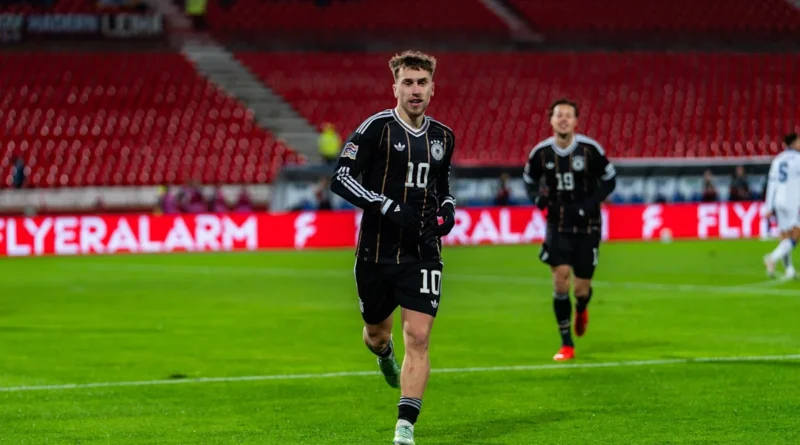
Why Brajan Gruda, not Florian Wirtz, is Germany’s next big talent
Germany is flying under Jürgen Klopp. The former Liverpool manager has only been in charge of the national team for six games, but the transformation is already difficult to ignore. Germany followed a 3-1 victory over Serbia with a statement 5-0 demolition of the Netherlands, securing top spot in their Nations League group in the process.
This 5-0 scoreline is particularly significant, considering Netherlands just downed Greece 7-0 in their previous game. Everyone expected this to be an interesting game, but no one was prepared for what they saw.
Yes, Florian Wirtz scored twice and looked much closer to the player Liverpool hoped they were signing. But there is another German attacking talent who might actually be the more exciting long-term prospect: Brajan Gruda.
Gruda has taken Germany from good to ridiculous
Gruda was supposed to be part of Klopp’s first Germany squads, but a stomach-muscle injury forced him to withdraw before the September international window. The 22-year-old had been included in Klopp’s plans, but had to wait for his opportunity.
Germany did OK without him. Die Mannschaft drew 1-1 with Holland before losing 1-0 to Greece in September, then beat Serbia 2-0 and drew 0-0 with Greece in the following international window. Against Serbia, Germany dominated possession and produced 16 shots before half-time alone, while Wirtz scored the second goal. Against Greece, they had 70.3% possession and 21 shots but couldn’t find a way through.
Germany was dominating possession, but the crispness in the final third was sometimes lacking. The 22-year-old Gruda is turning that possession into something dangerous.
Two games immediately showed why Gruda is different
Gruda’s Germany debut against Serbia immediately showed what had been missing.
He scored in the 3-1 victory, capping an excellent performance with a confident finish after a powerful run. Yet the goal was almost secondary to the way he attacked the game. According to Opta, Gruda completed 9/14 dribbles, the second-most successful dribbles by a German player in a single match over the previous decade.
That already showed his quality…then the Netherlands game came. This time Gruda wasn’t simply impressive, he was devastating.
Germany destroyed the Netherlands 5-0, with Gruda scoring one goal and providing two assists. He also recorded three key passes, created two big chances and finished with 13 touches inside the opposition box — all team-leading figures.
Get a step-by-step guide on how to analyze players like Gruda here.
In fact, he has recorded at least one goal involvement in each of his last four games in all competitions, including the 2-3 loss to Man City in the Champions League.
Watching the youngster against Xavi’s Netherlands, you can immediately see why his dribbling numbers are so rich. His quick feet make his next move anyone’s guess, which is a nightmare for defenders. He dropped a perfect assist for Wirtz for his second goal, meaning all the Liverpool forward had to do was smash the ball home from near point-blank range.
Wirtz has a high ceiling, Gruda has a high floor
This isn’t an argument that Wirtz is a bad player. In fact it’s the opposite. As talented as the Liverpool No. 7 is, Gruda’s talent seems a lot more polished already, which is the point.

Wirtz is still one of Germany’s most technically gifted players. His two goals against the Netherlands took him to four goals and an assist across his last three matches in all competitions. He can receive between the lines, combine in tight spaces and dictate attacks from central areas.
See how misprofiling Wirtz could lead to avoidable frustration in player evaluation
Gruda, though, offers something different, as he can just turn possession into something devastating through his passing and dribbling. His ability to equally affect the game through dribbling and passing reminds you of Lionel Messi.
Germany can pass the ball around a defence for 20 minutes, but eventually somebody has to break the structure. Somebody has to turn a harmless possession sequence into panic, and Gruda does that naturally.
His dribbling gives Klopp’s men an outlet when the passing lanes disappear. A willingness to attack defenders forces opponents backwards. His shooting gives him another way to punish teams that retreat too far, while his creativity means he can also turn those dribbles into chances for somebody else.
Sky Germany recently reported that Gruda had completed 36 Bundesliga dribbles this season, with only Lamine Yamal, Yan Diomande and Kylian Mbappé ahead of him across Europe’s top five leagues. His 7.03 successful dribbles per 90 minutes were the highest of any player in those leagues at the time.
Now he’s doing it for Germany.
Gruda just knows what to do with space
Wirtz is brilliant at finding space, but Gruda is brilliant at turning space into danger. That difference was clearly seen in the last game. Wirtz was waiting in the 6-yard box, while Gruda dribbled into the penalty area and simply dropped the ball on a plate for the former.
With the RB Leipzig forward, you’re damned if you do and damned if you don’t. If you stand off him, he’d hurt you with his passing, but if you rush him, he’d dribble you. If you try to contain him and hold your position, he’d run at you.
That combination of dribbling, shooting and chance creation makes him unusually difficult to contain. Germany doesn’t need to choose between Wirtz and Gruda. It’s not either…or, it’s both…and.
However, if we’re asking which under-24 Germany attacker looks capable of becoming the country’s next truly transformative talent, the answer might not be the obvious one.
Where Wirtz still needs the right circumstances to flourish, Gruda is already deciding games on his own, on the world stage.
LATEST POSTS
- Why Joao Pedro’s injury has become a problem for Chelsea
- Why Brajan Gruda, not Florian Wirtz, is Germany’s next big talent
- Joey Veerman is the spice Netherlands has needed for years
- Player Profile Analysis: Who is the ideal Premier League footballer? PART 2
- Player Profile Analysis: Who is the ideal Premier League footballer?
