
Football Tactics Explained: Tactical concepts made simple
Hold up. Before we start talking about football tactics, let’s talk about tactics generally.
Let’s step outside the football pitch for a second. A tactic is simply a strategy. That’s it.
For instance, when you need money for an Xbox from your dad and decide to do nice things for him before asking, that’s a tactic. Your strategy is to butter him up so that he’ll be more motivated to grant your request.
This means, of course, that tactics have something sitting at their heart: a goal.
In the example above, your goal was getting the Xbox, and your strategy was buttering your dad up.
Congratulations. You now understand tactics, and you pretty much understand football tactics too.
End of article. See you in the next one.
Football tactics can then be any strategy a team — usually laid out by the head coach or members of the coaching staff — uses to achieve a goal.
It could be long-term or short-term. Football teams have short-term goals such as winning games and avoiding defeats, as well as long-term goals such as challenging for major trophies.
Why are football tactics sometimes difficult to understand?
You see, football is a broad sport with so many moving parts and variables. This is why tactics in football can’t simply be one strategy leading to one outcome. There are many aspects of football, and each one needs a strategy of some kind.
As such, football tactics quickly start looking complex when you begin accounting for the different variables that go into deciding who wins a game. Often, when talking about football tactics, you need to be specific. This is because addressing the wrong thing will often set you on the wrong path.
Tactics themselves are relatively simple to understand. Football is what is complex, and that makes football tactics a broad and multifaceted topic.
To fully understand football tactics, we can break them down into four aspects: shape, phases of play, tactical styles and tactical roles.
Some of these aspects are selected by the head coach or manager, while others are things every team has to deal with regardless of the tactical style they use.
Formation (Shape)
A team’s formation in football is simply its starting shape or the starting position of its players on the pitch. When a game starts, the ball is in the centre and both teams arrange themselves. That arrangement is the formation.
As the game progresses, players will likely take up different positions and form different shapes. For most teams, there is a shape for when they are out of possession and a different one for when they have the ball.
This is because you need to be able to withstand pressure when you lose the ball and attack effectively when you have it. You cannot do both equally well with exactly the same shape.
I know you have day jobs, so I won’t go into the details of every formation. That’s for another article.
I will, however, highlight some common out-of-possession formations.
Many teams use a flat 4-4-2, 5-4-1 or 4-5-1 when they are without the ball. The four or five players in the midfield and defensive lines help make it difficult for opponents to create goalscoring opportunities with line-breaking passes.
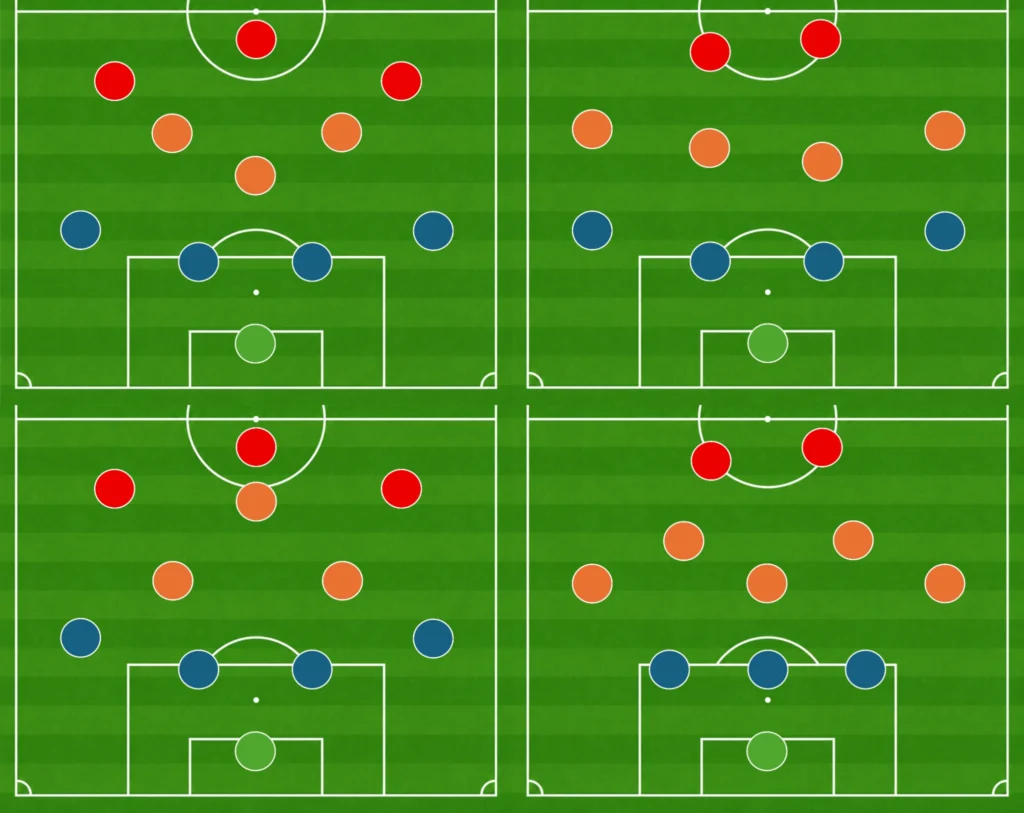
We’ll revisit formations when we discuss tactical styles, as some starting shapes are more suited to certain tactical styles than others.
Phases of Play
This is an aspect that every team will go through.
There are three fundamental phases of play: in possession, out of possession and transition.
In Possession (Attacking)
You may have heard the term “the attacking team” during match analysis or commentary. It doesn’t necessarily refer to the team actively driving forward and trying to score. It simply refers to the team that has possession of the ball.
They could all be standing still and would still be “the attacking team” simply because they have possession. As part of their tactics, the manager needs to decide what the players do when they have the ball.
Out of Possession (Defending)
If you understand the “in possession” phase, then you should understand the out-of-possession phase.
For every team in possession, there is one out of possession. A team’s shape when it doesn’t have the ball can be even more important than its shape in possession, because a team with decent technical skill can take apart another team with a weak out-of-possession structure, especially at the top level.
Transition
Transition simply refers to the moments between the two phases above. It is particularly important when a team moves from being in possession to being out of possession, or vice versa.
Many teams are vulnerable in these moments, and it can cost them goals and points.
This aspect of the game is one that every manager has to account for. In every game, every team has to deal with all three phases, regardless of the tactical style.
Of course, what teams do in these phases of play is usually dependent on the tactical style in effect. Everything a team does in these areas will be influenced by the style a coach has deployed.
And that brings us to tactical styles.
Major Tactical Styles
We’ll only discuss four here, even though there are many more.
We’re discussing these four because a huge number of teams in world football use at least one of them, or a variation of them. Some teams sit somewhere in between, but you can usually trace elements of their style back to one or more of these approaches.
Here they are.
Positional Play
Positional play, sometimes called Juego de Posición, is a tactical style that focuses on controlling the game by dominating possession of the ball.
It involves dividing the pitch into zones to maintain structure and create passing options. Creating passing options is central to this style because success requires numerical superiority in selected areas of the pitch.
The idea is to pull opposition players out of position and break down defensive blocks through patience and controlled possession. Managers such as Johan Cruyff and Pep Guardiola popularised this style and are strongly associated with it.
Guardiola has used it at Barcelona, Bayern Munich and Manchester City.
Gegenpressing
Gegenpressing is essentially a tactical style that focuses heavily on what happens immediately after possession is lost.
Let me explain. This style is built around immediately pressing the ball as soon as possession is lost. It involves high-intensity sprints from several players.
The idea is twofold:
- Win the ball back within a few seconds of losing it.
- Win the ball back as high up the pitch as possible to create high-value chances without having to build the attack from scratch.
This style requires tremendous stamina from players because they need to make many sprints in short periods.
See how Brighton destroyed Arsenal with gegenpressing
Counter-attacking
The idea behind counter-attacking is to absorb pressure from opposition attacks before breaking forward with pace, vertical passing and, sometimes, long balls.
This works because, when attacking, the opposition is often drawn far away from its defensive third, leaving space behind for a counter-attack.
A team set up to play this style needs to position its players strategically so that, when possession is won, the counter-attack can begin before the opponents have time to regroup into their defensive shape.
Low Block
The low block is a compact defensive shape positioned in a team’s defensive third, usually very close to its penalty area. Here, the idea is to deny the opposition space to play through the defence in an attempt to prevent goalscoring opportunities.
It is often deployed by teams that expect to have less possession or believe they can get a better result by defending deep and limiting space.
Each of these styles requires slightly different things from the players operating within them. Of course, they all need specific types of roles to be filled.
Positional play needs players with good ball retention, patience and very good passing ability.
Gegenpressing needs players with high stamina, quick decision-making skills and good passing.
Counter-attacking needs players with physical speed, good movement and high concentration.
A low block needs strong, disciplined players with high concentration and the ability to defend their own penalty area.
In these styles, players take up specific roles and, as you may have guessed, those roles are dependent on the style too.
Tactical Roles
Tactical roles are the functions performed by players within a specific system. A role can become something completely different when placed into another tactical style.
There are many roles on a football pitch, but they can roughly be broken down into seven.
Goalkeeper
This is the player whose job is to keep goals out. The goalkeeper reacts to the game and often has little control over how much work they have to do. However, modern goalkeepers can also play a major role in possession by helping their teams build attacks from the back.
Full-back
Depending on the tactical style, the full-back has duties both in and out of possession. However, their main job is to stop threats down the flanks while providing attacking support on their own side.
Their exact functions will vary depending on the style being played.
Centre-back
The centre-back (CB) is responsible for stopping threats that come through the middle of the pitch.
In positional play, they may also be expected to “start” attacks from the back with their passing. In this style, the centre-back has to be a good passer, or they won’t be a good fit.
Central midfielder
Like other roles, the central midfielder has duties both in and out of possession. When defending, they are expected to play a key role in winning the ball back in the middle third.
In possession, they are expected to start attacks and distribute the ball towards the final third, allowing the attacking players to do their thing.
Attacking midfielder
This midfielder mainly operates closer to — or inside — the penalty area. Their primary duty is to create goalscoring chances and link up with the other forwards to help their team consistently create and score goals.
Winger/Wide attacking midfielder
Essentially, this is what the attacking midfielder does, but from the flanks. They have the added duty of keeping track of opposition full-backs and helping their own team maintain width.
Striker
You already know that no game is won if no goal is scored, and the player tasked with scoring those goals is the striker.
Every tactical style is ultimately designed around two basic purposes: concede as few goals as possible and score as many goals as possible.
Some styles focus more heavily on one than the other. This means every tactical style needs reliable goalscorers, even if the way they create those goals differs.
What tactic should a manager use?
There are different ways of answering this question, and several iconic managers have different approaches. Some managers start with the tactical style and then get players who fit it. Others evaluate the players they have and then find a tactical style that fits them.
Guardiola, for example, goes into every job already planning to deploy positional play. So whoever fits that style stays, and whoever doesn’t is sent on his way.
For José Mourinho, on the other hand, the approach has often been to use tactical styles that fit the players available.
Mourinho’s approach is arguably more realistic for many modern managers.
This is because very few teams are able to get every player they want. Often, squads are a mixture of different player profiles, so it’s better to use a style that most of the players can execute effectively.
This means the manager needs to be able to coach different styles, and not many managers are that versatile.
This has been a looooooooong read, but it was only this short because I didn’t go into as much detail as I could have. If you understand football tactics better now, follow us on X and Instagram for other equally insightful — or even more insightful — articles and content like this.
LATEST POSTS
- Football Tactics Explained: Tactical concepts made simple
- Why Joao Pedro’s injury has become a problem for Chelsea
- Why Brajan Gruda, not Florian Wirtz, is Germany’s next big talent
- Joey Veerman is the spice Netherlands has needed for years
- Player Profile Analysis: Who is the ideal Premier League footballer? PART 2
