
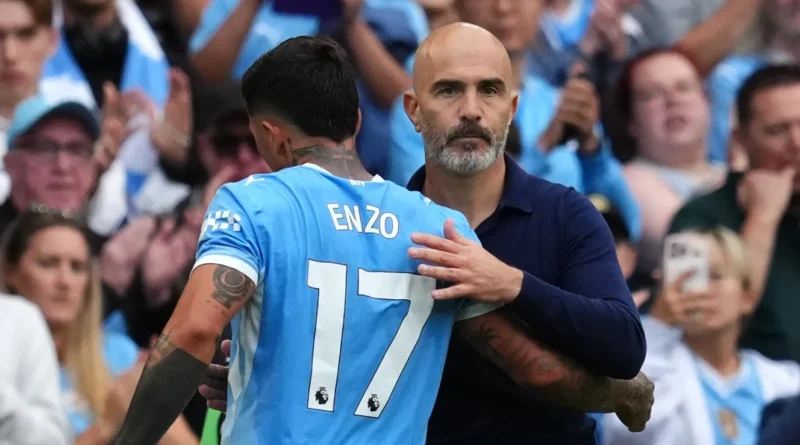
Why finishing is not actually Man City’s biggest problem right now
As of the morning of October 24, Manchester City was sitting pretty at the top of the Premier League table. Three games later, the club isn’t even in second place. This drop will surprise many fans, especially because the team had been on a seven-game league winning streak up until then.
After the 3-1 loss to Nottingham Forest, Man City fans expressed their frustration with head coach Enzo Maresca, and you get the feeling that the frustration is deepened by not knowing exactly what is wrong.
The 2023 Champions League winners have also been shaky in this year’s edition of the competition. Man City has several problems, and the “biggest” problem could well be a matter of perspective. Let’s get into some of them.
Is finishing the biggest problem Manchester City has?
In the last three games, you could trace Maresca’s problems to his team’s inability to finish chances.
Against Aston Villa, Brighton & Hove Albion and Forest, Maresca’s men created more shots and more clear-cut chances, but on all three occasions, they failed to convert enough of them to secure the win.
This problem hasn’t been there from the beginning of the season, and perhaps that’s why you’re only just noticing City’s flaws. Yes, finishing got worse over the last three weeks, but that is not why the club dropped from first to third. Even now, the attacking numbers are good.
Man City ranks first for open-play expected goals (xG) at 19.81, big chances (38), and total xG at 20.1. The club also ranks second for shots on target with 54, and sixth for set-piece xG at 4.0 and total shots with 150.
All of this comes while Manchester City ranks second for goals scored. Yes, the Cityzens will want to finish more chances, but they have a bigger problem.
The bigger problem: Defending
From Gameweek 1, Manchester City has not looked defensively solid. Maresca’s men kept one clean sheet in their first three league games, then two in the next four, and none afterwards. Three clean sheets from 10 games is not title-contending form.
These defensive issues aren’t necessarily down to the defensive structure, because the team is generally good out of possession.
I know that’s a strange thing to say considering the section this falls under. Yet the numbers show that City ranks third for shots faced (106), 7th for shots on target against (39), and third (10.87) for expected goals against (xGA).
The issue is that the club also ranks seventh for big chances conceded.
In 10 games, Manchester City has allowed an average of 2.6 big chances per game. This is the kind of statistic you can get away with on most days, but there will be days when you come up against teams that take their chances. In fact, against Sunderland, the Cityzens gave up eight big chances!
Maresca’s men don’t give up many shots, but when they do, those shots tend to come from high-probability areas.
This is not particularly strange, as it is an unwanted consequence of Man City’s style of play. A high line means you win the ball back very quickly after losing it most of the time. On the occasions when you don’t, however, you can end up conceding high-quality chances.
That proportion is what City is getting wrong.
Brighton is what Manchester City wants to look like. The Seagulls are leading nearly every attacking metric and are doing even better than City in some areas. At the same time, they are doing as well as Arsenal defensively, having conceded only seven goals and kept the same number of clean sheets.
For comparison, Arsenal has allowed five goals and also kept seven clean sheets.
Goalkeeping hasn’t helped
This season, Gianluigi Donnarumma has fallen well below the acceptable save rate for a Premier League goalkeeper: 70%. Last season, Man City kept an impressive defensive record, thanks in part to the Italy international, who put up an impressive 73% save rate while keeping out more than five goals he should have conceded.
This season, that figure has dropped to 66%. Against Villa and Forest, he was particularly horrendous. He’s still a top goalkeeper, and he’s not allowing more goals than he should, but for a player at his level, he’s underperforming.
That said, fixating on this would take away from the main point.
How can Manchester City fix this?
If you’ve been watching, Maresca has been making some funny midfield-pivot decisions.
In fact, since the 2-4 Paris Saint-Germain (PSG) loss, he has used the Enzo Fernandez-Elliot Anderson double pivot five times in all competitions, and Manchester City has lost three of those games.
Read this article on why that particular pivot was a bad idea against PSG.
Now, it’s easy to understand why he’s doing it. However, it’s the refusal to admit that it isn’t working that is frustrating fans. That pivot doesn’t work because neither player is a natural sitting midfielder. Maresca continues to use them, opponents continue to find clear-cut chances, and the team continues to concede needless goals.
Maresca already has all he needs to fix his defence. The issue is the political side of things.
Why a Fernandez-Anderson pivot in the first place?
I said before that it’s easy to see why he starts those two. The first reason is that Maresca wants to play a 4-2-3-1.
The second reason? Those two are senior players — and they cost a lot of money.
Man City broke the transfer record twice in the last window. The first time was for central midfielder Elliot Anderson, who played as a box-to-box midfielder for Nottingham Forest. The second was when the club dragged Fernandez from Chelsea for a whopping €145m. This immediately puts Maresca in a pickle.
He has to play them. He cannot justify — not to the club board, anyway — leaving a €100m player on the bench. This is why clubs need to think carefully before spending huge sums on players. It’s not just about getting the player you want; it’s about avoiding these kinds of problems further down the line.
Now Maresca has two players who don’t work particularly well together, but benching one could create unrest that he may not yet know how to navigate. It’s even funnier because the solution to the problem, Ayyoub Bouaddi, also cost close to €100m.
Maresca now has to find a way to bring Bouaddi into the starting line-up consistently while keeping his more expensive senior players happy.
The youngster’s impact was glaring in the PSG game. That is particularly telling because the game did not lack quality central midfielders, yet the 19-year-old stood out. He’s special.
Ultimately, the players are Maresca’s to do with as he pleases, and he can bench whoever he feels won’t help the team. But he has to be wise. He needs senior players on his side, especially as he’s still new. How Maresca handles this will determine how far he goes as Manchester City manager.
His predecessor went 10 years, no pressure, Enzo.
- Why Joao Pedro’s injury has become a problem for Chelsea
- Why Brajan Gruda, not Florian Wirtz, is Germany’s next big talent
- Joey Veerman is the spice Netherlands has needed for years
- Player Profile Analysis: Who is the ideal Premier League footballer? PART 2
- Player Profile Analysis: Who is the ideal Premier League footballer?

Good analysis — the defensive numbers really stand out after the Forest defeat, and I kept thinking about how exposed City looked on transitions. I was following the game closely and later used rbtv77 live tv stream free to catch up on the key moments again.
Thank you. Yes that’s the issue they keep facing. They’d have more wins if they didn’t concede unnecessary goals in games they should’ve been comfortable. Allowed 8 big chances vs Sunderland
Good point that City’s real problem is defending rather than finishing — I usually catch the big matches after the football here smackdown full episode free.