

Man City’s 115 charges scandal gives the Premier League a golden chance
Manchester City has been found guilty 114 out of the 115 charges brought against them. In the first place, the 115 charges were a source of jokes, memes, banter and extensive podcast conversations. The allegations don’t surprise many, but others are only just realizing just how deep this goes.
Sheikh Mansour took over Man City in 2009, and needless to say, the new ownership has turned the club’s fortunes around, in more ways than one. In many ways, the blue side of Manchester has enhanced the reputation of the Premier League, especially with the disruption of the status quo and making the league more competitive.
Are you a football writer looking for a platform that will push you and help you grow? You can become a writer for The Ddraft. We know how hard it is for you to get your writer career off the ground. We’re here for you. Send an email to theddraftofficial@gmail.com
Yet, in other ways, their arrival has made the league into a joke. And no, not because of how easily they won titles. Actually, it’s exactly because of that. The Premier League has always been a difficult league to win. Established clubs won trophies consistently, because they spent decades building. Sometimes centuries. Investment has always been a good thing for a club, but the recent charges, and verdict, indicate that there was more to Man City’s success than just investment and football brilliance.
How the 115 charges affect the Premier League’s reputation
The spending rules the Premier League put in place were to protect…the clubs. There’s a reason the league did not allow clubs to spend over a percentage of their revenue on transfers. Perhaps more importantly, there’s a reason the league stopped you from incurring more than a certain amount of losses in a certain period.
This was, in part, to make sure that clubs did not self-destruct, as too many clubs were going into administration due to bankruptcy. Some other clubs were on the brink, and while you could say no one should stop clubs from self-destructing if they want, there are others in the equation. Playing and non-playing staff are often the most vulnerable in these situations, so the Premier League was responsible for protecting them.
The other reason, which is equally as important as the first, is to maintain the integrity of the league, regarding competition. Football is a marathon, not a sprint. All other clubs in the Premier League Big 6 today built over the years, got investment, and then expanded. The consequences of this are growth in stature, bigger stadiums, and winning trophies.
Obviously that doesn’t apply to every club in the same way. Tottenham doesn’t really win trophies, but they maintained Champions League football for long enough to build a 62,000-seater stadium. That’s over 20,000 more than Chelsea’s.
What this verdict shows is that Man City cut through the process and went straight for glory. And did it in illegal ways. This is why the Premier League must decide how much competitive integrity means to them.
If they gave Man City the practical equivalent of a slap on the wrist, that will encourage the next club who wants to break these rules. After all, what is a transfer ban and a fine when you have three league titles and all the revenue and bonuses that come with it?
A page from Serie A’s book
You may remember that in 2006, the Italian Football Federation (FIGC) investigated Juventus and five other Serie A clubs for a number of allegations. Some of these allegations included trying to influence games by controlling the referee assignments. The FIGC also investigated the 36-time Scudetto winners for influencing games by controlling player selections through bookings.
It was big, with a lot of information coming to light about the various conflicts of interest at play. The media called it Calciopoli, and it was the biggest scandal in Italian football. There have been others, but none as big.
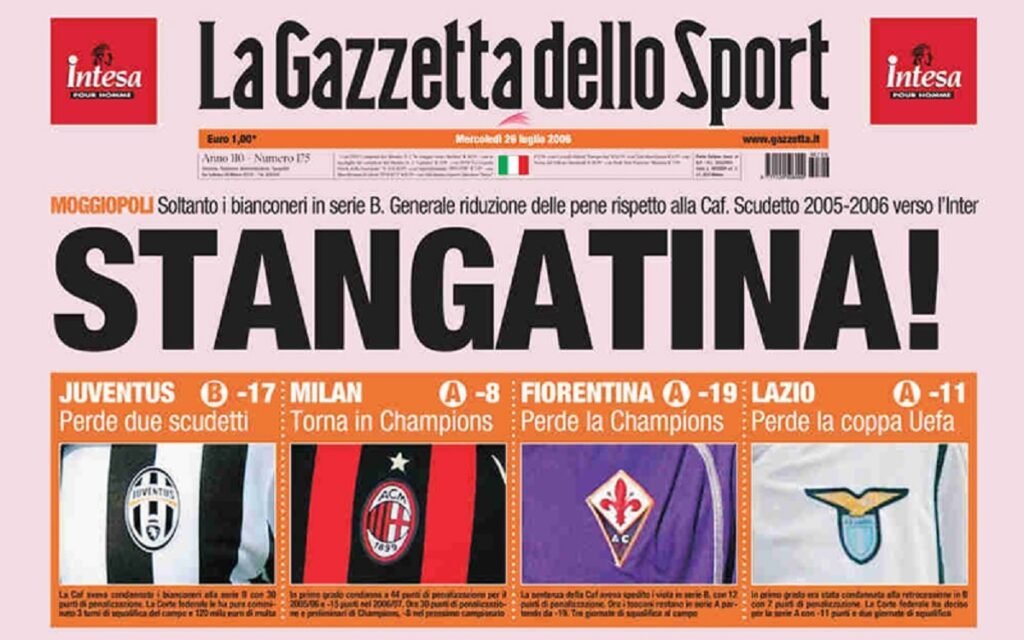
The point, is that Juventus was found guilty. Other guilt parties include AC Milan, SS Lazio, ACF Fiorentina, AS Reggina, and Arezzo. The FIGC hit Juve hardest, and as a result, relegated them from the Serie A.
Keep in mind that the 2006 scandal is one of six in Italy’s football history, but they still meted out punishment to avoid other leagues seeing football corruption as “normal” in its country.
This is why the Premier League should seriously consider taking a page or two from FIGC’s handbook. The league may need to deliver a punishment that is just as serious, if not more serious than what Juventus got. It would only be fair, as Man City did far worse than the Italian giant.
What would be considered a “slap on the wrist”?
Anything below a relegation. A fine will not affect Man City, because they were able to contravene these rules in this way due to having too much money in the first place. A points deduction would only be sufficient if it leads to a relegation. A transfer ban will not be as effective because the club has always had more players than needed.
- Tactical Analysis: Why Barcelona and Real Madrid face two different problems
- Man City’s 115 charges scandal gives the Premier League a golden chance
- Is Lamine Yamal begging for the Ballon d’Or?
- Manchester City’s 115 charges: What does it mean for Manchester United?
- Player Analysis: The Florian Wirtz you want vs the one you have
Ideally, the Premier League should apply all three punishments together. A sufficient fine and a healthy points deduction, in addition to a relegation, maybe even two.
Here’s what I do want you to leave with, though. No matter how serious you think these 114 guilty charges are, they’re a lot more serious than that, and the Premier League should address it accordingly. There’s a lot of money in football, and the last thing the league wants is for anyone to get the impression that you can blatantly disregard the rules and get away with it.